
Sheep Worrying: Using Cameras to Protect Livestock from Dog Attacks
Every sheep farmer knows the scene: a dog "just playing" at the far end of the field, an owner shouting a name it's ignoring, and a flock of in-lamb ewes packed into a corner, sides heaving.
The cost of that scene is rising. Dog attacks on livestock cost UK farmers an estimated £1.95 million in 2025 — up 10% on the year before — with the Midlands (£438,000) and South East (£330,000) worst affected. And it's not a rare event: 87% of sheep farmers say they've experienced dog attacks on their flock in the past year.
The law has finally caught up. The Dogs (Protection of Livestock) (Amendment) Act 2025 replaces the old £1,000 maximum fine with an unlimited fine and gives police real investigative powers — seizing dogs, taking DNA samples, entering premises to secure evidence. But those powers only bite when there's evidence to act on. An attack witnessed by nobody, in a field visited once a day, goes nowhere.
The problem is that sheep fields are the definition of off-grid: no WiFi, no mains power, no buildings — and often a public footpath running straight through the middle. That's exactly why we built the Farmstream Solar 360 Mini — a solar-powered, 4G-connected livestock field camera that works anywhere with a mobile signal.
Published ahead of lambing for a reason: the weeks when your ewes are heaviest are the weeks a chase does the most damage. This guide covers the scale of the problem, what the new law means for you, and how to put eyes on your most vulnerable fields before the season starts.
Sheep Worrying: The Scale of the Problem

"Worrying" undersells it. A dog doesn't need to bite a sheep to kill it. Chasing alone causes in-lamb ewes to abort, drives flocks through fences and into ditches and rivers, separates lambs from mothers, and kills sheep outright through shock and exhaustion. Then there are the attacks themselves — and any farmer who has found the aftermath doesn't need it described.
The numbers say it's getting worse, not better:
- £1.95 million: the estimated cost of livestock worrying to UK farmers in 2025 — a 10% rise on 2024, according to NFU Mutual.
- 87% of sheep farmers experienced dog attacks on their flocks in the past year.
- The Midlands (£438,000) and South East (£330,000) saw the highest regional costs in England.
The uncomfortable truth is in NFU Mutual's survey of dog owners: 57% let their dogs off the lead in the countryside, 10% admit their dog has no recall at all, and 44% say their dog comes back only "some" or "most" of the time. Around two-thirds believe their dog is incapable of harming livestock, and 72% aren't actively doing anything to prevent it. Your flock's safety currently depends on the judgement of people who mostly believe the problem doesn't apply to them.
And the damage clusters exactly when your flock is most vulnerable: the pre-lambing and lambing months, when heavily pregnant ewes can't run and newly turned-out lambs can't keep up. It's why the National Sheep Association times its #LeadOn awareness campaign for the peak lambing period — and why the weeks before turnout are the right time to get a camera on the field.
A livestock field camera earns its keep four ways:
- Deterrence: A visible camera and signage at the footpath gate is the point where most owners reach for the lead. The 57% who let dogs off-lead behave differently when they know they're on film.
- Detection: Smart motion alerts tell you the moment a person or dog enters the field — while there's still time to intervene, not after you find the aftermath at morning feeding.
- Evidence: Timestamped HD footage of the dog, the owner, and the vehicle turns "it was a brown dog, maybe a spaniel" into a case the police can actually pursue under the new Act.
- Reassurance: A sweep of the lambing field from your phone at 11 pm — ewes settled, gates shut, nothing moving — without pulling your boots back on.
But traditional wired CCTV simply doesn't work in a sheep field. You need a camera that operates independently — no broadband, no mains power, and no specialist installation. That's where solar-powered 4G security cameras come in.
The New Livestock Worrying Law: What Changed in 2025
For seventy years, the law on livestock worrying was the Dogs (Protection of Livestock) Act 1953 — with a maximum fine of £1,000 that hadn't deterred anyone in decades. That changed when the Dogs (Protection of Livestock) (Amendment) Act 2025 became law on 18 December 2025, applying to England and Wales. Here's what it means for sheep farmers:
- Unlimited fines: The £1,000 cap is gone. Courts can now impose unlimited fines, and can order offenders to cover the costs of seizing and detaining their dogs.
- Real police powers: Police can now seize and detain dogs, take samples and impressions from a suspected dog, and enter premises to secure evidence — including animal DNA. Attacks that previously died for lack of proof can now be properly investigated.
- Wider coverage: Protection now extends to roads and paths — covering flocks being moved between fields — and the definition of livestock now includes camelids such as llamas and alpacas alongside sheep and cattle.
- Attacking vs worrying: The Act distinguishes more clearly between dogs attacking livestock and dogs worrying livestock, reflecting the fact that a chase can be as deadly as a bite.
The catch: every one of those new powers runs on evidence. DNA sampling needs a suspect dog; an unlimited fine needs a conviction; a conviction needs proof of which dog, whose dog, and when. In a field you visit once or twice a day, that proof simply doesn't exist unless something is recording. The new law has effectively made footage the most valuable thing a livestock farmer can own after the flock itself.
It's also worth saying what a camera saves you from. Farmers do have a long-standing defence under the Animals Act 1971 for shooting a dog caught worrying livestock as a genuine last resort — but nobody wants that conversation, that risk, or that day. An alert on your phone while the dog is still at the gate, a voice through the camera's speaker, and a clip for the police is a better ending for everyone, including the dog.
Why the Solar 360 Mini Is Ideal for Sheep Fields
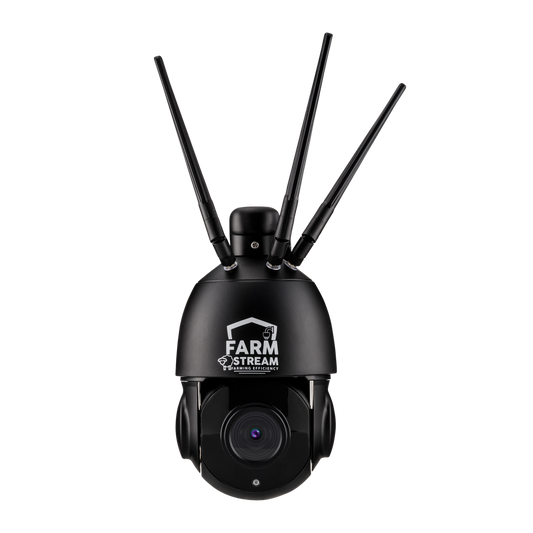
The Farmstream Solar 360 Mini was designed for exactly these conditions. At just £199 — less than the value of a couple of in-lamb ewes — it's a fully self-contained off-grid security camera that runs entirely on solar power and connects via 4G. No wiring, no broadband, and no electrician needed.
Here's why sheep farmers are choosing it:
- Completely off-grid: The included 26 W solar panel and built-in battery keep the camera running 24/7 — even through overcast UK winters and the short days of lambing time.
- No WiFi needed: The built-in eSIM auto-connects to the strongest 4G network in your area (EE, Vodafone, Three, or O2).
- 3MP HD video (2560 × 1920): Sharp enough to identify a dog's breed and colouring, an owner's face, and a number plate in the gateway.
- 355° pan and 90° tilt: Sweep the whole field — footpath, gateways, boundaries, and far corners — from a single camera position.
- Auto-tracking: Detects movement and automatically follows a person — or a loose dog — moving through the field.
- 20–30 m infrared night vision: Clear footage after dark, when out-of-hours walkers, poachers, and loose dogs go unseen.
- Two-way audio: Ask an owner to put their dog on a lead the moment the alert comes through — from the kitchen, the lambing shed, or the mart.
- Smart push alerts: Get notified on your phone the moment a person or vehicle enters the field.
- 64 GB on-board storage: Records approximately 2–3 weeks of continuous 24/7 footage (upgradeable to 256 GB).
- IP66 weatherproof: Built for exposed grazing, driving rain, and everything a UK winter throws at a fence post.
- Portable and relocatable: Follow the flock — move the camera from the in-bye to the lambing paddock to away grazing in minutes.
For long views across big fields or multiple paddocks, you can pair the Solar 360 Mini with the Farmstream 360 (4K PTZ) for additional long-range coverage of gateways and boundaries.
Key Features to Look For in a Livestock Field Camera
Not all security cameras suit a working sheep enterprise spread across off-grid fields. Here's what matters most when choosing a livestock field camera — and how the Solar 360 Mini delivers:
- No power dependency: Solar with built-in battery means no generators, extension leads, or trenching cable out to the field. The Solar 360 Mini includes a 26 W panel designed specifically for UK light conditions.
- No WiFi dependency: 4G connectivity with an auto-switching eSIM means you can deploy at any field with mobile coverage — including away grazing miles from the farmhouse.
- Instant motion alerts: The difference between interrupting a chase and photographing the aftermath. An alert while the dog is still in the field gives you a chance to intervene; anything else is just a record of what it cost.
- 24/7 recording: Continuous recording to the on-board SD card means every walker, every loose dog, and every incident is captured — even if you never open the app that day.
- Remote pan, tilt, and zoom: Check the flock, the gateways, and the water trough between visits — from your phone, not the quad.
- Auto-tracking: The camera detects and follows movement automatically, keeping a person and their dog in frame across a big open field.
- Two-way audio: A polite "please put your dog on a lead" through the speaker resolves most situations before they become incidents — and puts irresponsible owners on notice that the field is watched.
- Number plate capture: Most repeat offenders arrive by car and park in the same lay-by. 5MP resolution resolves plates in the gateway, and infrared keeps them readable after dark.
- Multi-user access: Share camera access with family, shepherds, and anyone who checks stock — there's no limit on connected devices, so whoever's nearest can respond to an alert.
Solar-Powered CCTV: No Mains Power in the Field? No Problem

Sheep fields don't have plug sockets. The fields where worrying happens most — the ones alongside villages, car parks, and popular footpaths — are usually a long way from the yard, and running armoured cable out to a field gate is expensive, disruptive, and impossible to justify across multiple blocks of grazing.
The Solar 360 Mini solves this entirely. It ships with a 26 W solar panel (400 mm × 350 mm) and a 2 m cable, so you simply mount the panel in an unshaded spot near the camera and you're done. The built-in battery stores enough energy to keep the camera running through the night and on cloudy days.
Thanks to intelligent power management and energy-efficient standby modes, the camera remains operational year-round — including December to April, when daylight is shortest, ewes are heaviest, and the field is dark for sixteen hours a night. If the timing seems inconvenient, it's not a coincidence: peak vulnerability and minimum daylight arrive together, and the camera is engineered for exactly that window.
This makes solar-powered CCTV ideal for sheep fields, lambing paddocks, away wintering, and any block of grazing that lives at the far end of the farm — anywhere a camera needs to work without a plug socket in sight.
4G Cameras for Fields Without Internet
There's no broadband in a sheep field. The Solar 360 Mini connects directly to the mobile network using its built-in eSIM, which auto-switches to the strongest available 4G signal in your area — whether that's EE, Vodafone, Three, or O2.
How 4G data works with livestock field cameras:
- The camera records 24/7 to its internal 64 GB SD card — this uses zero 4G data.
- 4G data is only consumed when you view live or recorded footage through the CamHipro app.
- Push notifications (motion alerts) use negligible data.
Farmstream's 4G Streaming Plan costs just £89/year and includes 50 hours of live viewing — more than enough for daily stock checks and reviewing any incidents. Monthly and higher-usage plans are also available.
The camera is also fully unlocked, so you're free to use your own data SIM if you prefer.
What a Camera Costs vs What an Attack Costs
Sheep farmers who look into CCTV usually get quotes for a professionally installed wired system — and discover it needs power and broadband the field doesn't have, at a price the enterprise can't carry. Here's how the costs actually compare:
| Solar 360 Mini | Installed Wired CCTV | |
|---|---|---|
| Upfront cost | £199 (you own it) | Installation, trenching & cabling (typically £1,000+ per camera position) |
| Ongoing cost | £89/year (optional 4G plan) | Maintenance contracts, electricity |
| Needs mains power | No — solar + battery | Yes — limits camera positions |
| Needs broadband | No — built-in 4G eSIM | Yes, for remote viewing |
| Coverage hours | 24/7 recording + smart alerts | 24/7 |
| Follows the flock | Yes — relocate in minutes | No — fixed positions |
| Remote access via app | Yes — free CamHipro app, unlimited users | Sometimes (extra cost) |
| Self-install | Yes — under 10 minutes | No — engineer visit required |
Now put the £199 against the other side of the ledger. A single serious attack can kill or injure multiple ewes, abort a season's lambs from the survivors, and cost days of your time in vet visits, carcass disposal, and police reports — before you count the excess and premium impact of an insurance claim against a national bill that hit £1.95 million in 2025. One camera on the footpath field is £199, once. Covering the footpath field, the lambing paddock, and a roadside boundary is £597 — and every camera is still yours next season, wherever the flock goes.
Where to Mount: Footpath Gates, Lambing Paddocks & Boundaries

The Solar 360 Mini ships with pole mount fixings, screws, and fittings — so installation in the field is straightforward without specialist tools. Common mounting locations for sheep enterprises include:
- The footpath gate or stile: The single most valuable position. Nearly every worrying incident starts here — a walker, a dog, and a decision about the lead. A visible camera and a "CCTV in operation — please keep dogs on leads" sign at the kissing gate changes that decision, and records everyone who makes the wrong one.
- The lambing paddock: For the weeks that matter most, a camera on a 3–4 m post overlooking the lambing field gives you motion alerts by night and a flock check from your phone by day — heavily pregnant ewes, newborn lambs, and everything that shouldn't be near them.
- Field gateways and the roadside: Repeat offenders tend to park in the same lay-by and use the same gateway. A camera covering the gate captures vehicles and number plates — and deters the poachers, hare coursers, and fly-tippers who use the same access.
- Vulnerable boundaries: If one fence line backs onto a village, housing estate, or car park, that's where escaped and unaccompanied dogs come from. Point a camera along it.
- Away grazing: Rented keep and away wintering are checked least and worried most. A self-contained camera means distant blocks get the same oversight as the in-bye.
Mount it high. A camera at head height invites tampering; a camera at the top of a 3 m post — well out of arm's reach — is visible enough to deter, safe from interference, and still close enough to identify a dog, an owner, and a plate. Use the included anti-tamper bolts, and angle the camera to cover its own approach so anyone coming for it is recorded first.
Because the Solar 360 Mini is completely self-contained, you can relocate it in minutes — just unbolt, move, and remount. In-bye for lambing, footpath field for summer, away grazing for winter: the camera follows the flock. No rewiring, no reconfiguration. The camera reconnects to 4G automatically.
Important: Mount the solar panel within 2 m of the camera (the cable cannot be extended) and ensure it's positioned in an unshaded spot for reliable charging — worth remembering on tree-lined boundaries, where mounting above the hedge line usually solves it.
Setup in Under 10 Minutes
The Solar 360 Mini is a true plug-and-play livestock field camera. No IT knowledge, no network configuration, and no specialist installer required.
Four steps to get your flock watched:
- Mount the camera where there's good 4G coverage — on a post by the footpath gate, the lambing paddock, or a vulnerable boundary.
- Mount the solar panel in an unshaded spot within 2 m of the camera.
- Download the free CamHipro app on your phone and scan the QR code on the camera.
- Start viewing, recording, and receiving alerts — you're live.
Multiple devices can connect to the same camera, so you, your family, and anyone who checks stock can all get alerts and view the feed from their own phones. There's no limit on the number of users per camera.
Case Study: Upland Flock with a Footpath Problem
A sheep farmer in the Peak District runs 400 ewes, with lambing in April and a popular public footpath crossing the two fields closest to the village. Every spring brought the same pattern: dogs off the lead, ewes bunched against the far fence, and — twice in one season — the worst of it. One attack left three ewes dead and several more aborting in the following days. The police were sympathetic but blunt: no description of the dog or owner, no case.
Before the next lambing, he installed two Solar 360 Mini cameras — one on a post beside the footpath kissing gate, one on a 3 m pole overlooking the lambing field — and added CCTV signage at both ends of the footpath.
The change was immediate and mostly invisible: walkers now arrive at a gate that tells them the field is monitored, and the leads go on. Motion alerts flag every entry to the field, so an off-lead dog gets a polite request through the camera's two-way audio while it's still at the gate — which has so far ended every incident before it started. The one owner who ignored it was captured in 5MP heading back to a car in the lay-by; the clip, the plate, and the timestamps went to the police, who paid the owner a visit under their new powers instead of filing the report in a drawer.
Lambing itself got easier too: late-night flock checks now happen from the kitchen, and the camera's night vision has flagged more than one ewe in trouble hours before the morning round would have found her.
Total cost for two Solar 360 Mini cameras: £398. Less than the ewes lost in a single attack — and the cameras are his for good.
What to Do After an Attack: Evidence, Police & Insurance
If the worst happens, what you do in the first hours determines whether the new law works for you:
- Call the police: 999 if an attack is in progress, 101 to report an incident afterwards. Livestock worrying is a criminal offence — insist on a crime reference number. You can also report information anonymously via Crimestoppers on 0800 555 111.
- Export your footage promptly: Save clips of the dog, the owner, and any vehicle, with timestamps intact, and keep the originals. The camera's SD card overwrites oldest footage first, so don't leave it weeks.
- Document the damage: Photograph injured and dead animals before moving them, keep vet reports and invoices, and record dates of any subsequent abortions — losses often continue for days after a chase.
- Tell your insurer: Livestock worrying claims are exactly what the footage is for — a clear recording removes any argument about what happened, when, and to how many animals.
- Let the new powers do their job: Under the 2025 Act, police can seize the dog, take DNA samples, and enter premises to secure evidence — and courts can impose unlimited fines. Footage that identifies the dog and owner is what sets all of that in motion.
One more point on filming: a public footpath crossing your field doesn't stop you operating CCTV on your own land. Comply with UK GDPR — clear signage at the access points, camera angled to cover your field rather than neighbouring property, footage stored securely with access limited to authorised people. The Solar 360 Mini stores all footage locally on its on-board SD card, and remote viewing through the CamHipro app uses a secure encrypted connection — helping you stay compliant while protecting the flock.
FAQs
What is sheep worrying?
Sheep worrying is when a dog attacks or chases sheep in a way that could cause injury, suffering, abortion in pregnant ewes, or loss of produce. It's a criminal offence — and under the Dogs (Protection of Livestock) (Amendment) Act 2025 it now carries an unlimited fine in England and Wales. A dog doesn't need to make contact: chasing alone can cause ewes to abort or die of exhaustion and shock.
How much does a sheep worrying camera cost?
The Solar 360 Mini is a one-off purchase of £199. The optional 4G streaming plan is £89/year (50 hours of live viewing). Recording 24/7 to the SD card uses no data at all, and the camera is fully unlocked if you'd prefer to use your own SIM.
Do I need WiFi or mains power in the field?
No. The Solar 360 Mini runs entirely on its included 26 W solar panel and built-in battery, and connects directly to 4G using its built-in eSIM — which auto-selects the strongest network in your area. No broadband, no router, no mains power required.
Can a camera actually stop dog attacks on sheep?
Deterrence does most of the work: a visible camera and signage at the footpath gate is the point where leads go on. When a dog does get loose, motion alerts give you the chance to intervene through the two-way audio while it's still happening — and if the worst occurs, the footage identifies the dog and owner so police can act under the new law.
What's the law on dogs attacking sheep in the UK?
Livestock worrying is a criminal offence under the Dogs (Protection of Livestock) Act 1953, and the 2025 Amendment Act raised the maximum penalty in England and Wales from £1,000 to an unlimited fine. Police can now seize dogs, take DNA samples, and enter premises to secure evidence, and protection extends to roads, paths, and camelids like llamas and alpacas.
What evidence do police need after a dog attack on sheep?
Timestamped footage of the dog and owner, vehicle registrations, dates and times, photographs of injured or dead animals, and vet reports. Report on 101 (999 if in progress), export clips promptly, and keep the originals with timestamps intact — under the 2025 Act, police can match a suspect dog to an attack using samples and DNA.
Can I point a camera at a public footpath crossing my land?
Yes, with sensible care. You can film your own land, including where a right of way crosses it, provided you comply with UK GDPR: clear CCTV signage at the access points, cameras angled to cover your field rather than neighbouring property, footage stored securely, and access limited to authorised people.
Will a solar camera work through a UK winter and lambing season?
Yes. The 26 W solar panel is designed for UK light conditions and the built-in battery covers overnight and overcast periods. The camera automatically adjusts its power usage during shorter daylight hours — so it runs right through the December–April window when the flock is most vulnerable.
How much footage can the camera store?
The included 64 GB SD card holds approximately 2–3 weeks of continuous 24/7 recording. You can upgrade to a 256 GB card for longer retention. Once full, the oldest footage is automatically overwritten — so export clips of any incident promptly.
Can my family or shepherd view the camera too?
Yes. There's no limit on the number of devices that can connect to a single camera. Share access with family and anyone who checks stock — each person just needs the CamHipro app and the camera's login details, so whoever's nearest can respond to an alert.
Protect Your Flock This Lambing Season — From £199
The Solar 360 Mini gives you 5MP HD livestock field security with pan, tilt, auto-tracking, night vision, and two-way audio — powered entirely by solar and connected via 4G. No WiFi, no mains power, no specialist installation. Mount it by the footpath gate before the ewes go out, and every walker, every dog, and every incident is on record. At £199, it costs less than a couple of in-lamb ewes — and it protects all of them.

Free UK shipping · Same-day dispatch before 2 pm (Mon–Fri) · 30-day money-back guarantee · UK-based phone support