

Clay Pigeon Shooting Ground Security Cameras: Protecting Traps, Batteries & the Clubhouse
Every ground owner has done the same mental arithmetic at lock-up: forty-odd automatic traps out on the sporting layout, a grand or more each, spread across a hundred acres of woodland — and not a soul on site until Wednesday.
It's arithmetic thieves have done too. When trap theft spates have swept the country, the pattern reported by clubs has been strikingly consistent: grounds across Gloucestershire, Wiltshire, Berkshire and Hampshire hit within days of each other, thieves walking past some traps to take specific models — even lifting traps off towers — and taking the batteries, machinery, and in one Lincolnshire case a 5kVA diesel generator along with them. That's not opportunism. That's shopping to order.
The problem for grounds is the same one that runs through all rural security: the kit that needs watching sits exactly where cameras have never been able to go. Sporting stands scattered through woods and valleys, a high tower on the far boundary, a trap store by the top gate — no mains power, no broadband, nothing but a 12V battery under each trap. Wired CCTV covers the clubhouse and stops there.
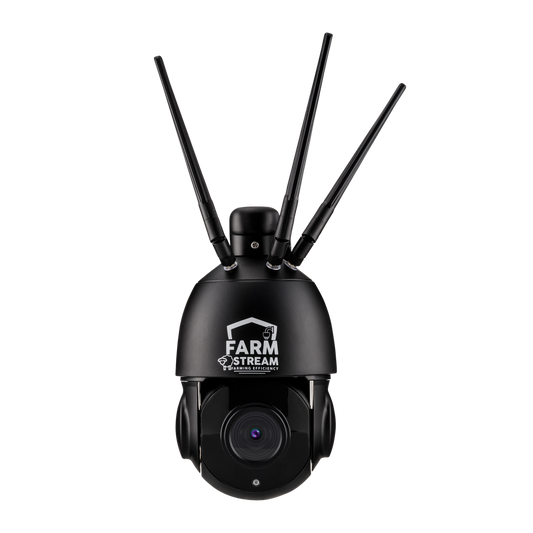
That's exactly why we built the Farmstream Solar 360 Mini — a solar-powered, 4G-connected security camera that works anywhere on the ground with a mobile signal. No wiring, no WiFi, no trenching cable through the covert. This guide covers what actually gets stolen from clay grounds, where to put cameras, and how to make the footage count.
Why Thieves Target Clay Shooting Grounds

A clay ground is, from a thief's point of view, close to ideal. It concentrates tens of thousands of pounds of portable, resaleable machinery in one rural location — and then empties completely. Most grounds shoot two or three days a week; commercial grounds are quiet overnight; club grounds on farmland may see nobody between Sundays. Everyone locally knows the shoot days, because they can hear them.
Three things make the target even softer:
- The kit is spread out and unwatched. An English Sporting layout might run 20–40 stands across woods, banks, and valleys. Traps sit out on those stands with their batteries — some grounds bring kit in nightly, but on a big layout that's hours of Gator work, so much of it stays put.
- The kit is easy to sell. Automatic traps from the major makers hold their value, look identical from ground to ground, and rarely carry visible identification. When Bridgnorth Gun Club had five traps stolen, the club published the details online and had a suspected eBay listing flagged within an hour — which tells you both how fast stolen kit resurfaces and how much recovery depends on evidence and serial numbers.
- It sits inside a wider rural crime wave. Clay grounds share their lanes, gateways, and visiting criminals with the farms around them. NFU Mutual put the cost of UK rural crime at £44.1m for 2024 — and the same vehicles scouting farmyards for quads and GPS units clock the trap store on the way past. One club reported battery thieves on their ground the same night the neighbouring farm's tractor battery was attempted.
Common Mistake
Assuming remoteness is security. The instinct at a quiet rural ground is that nobody knows the kit is there. In the documented theft spates the opposite was true: thieves bypassed cheaper traps to take specific models, which means they'd either visited as customers, walked the ground beforehand, or were stealing against a shopping list. Treat every open day as a day the ground was scouted — because occasionally it was.
And theft isn't the whole exposure. Grounds also deal with vandalism and arson of buildings and booking-in cabins, fly-tipping on the access track, and — uniquely serious for a shooting ground — trespassers on a live layout, which is a safety and insurance problem before it's a crime problem. A camera on the gateway answers all of it with the same footage.
What Actually Gets Stolen (It's Not the Guns)
Worth saying plainly, because it's the first question non-shooters ask: clay grounds are not generally raided for guns. Shooters bring their own shotguns and take them home; grounds that hold guns or cartridge stock do so under strict licensing and secure-storage conditions, typically inside the clubhouse or gunroom. What goes from clay grounds is the working kit:
- Automatic traps — the headline loss. A single commercial-grade automatic trap costs £1,000–£4,000+ depending on model and capacity, and a ground runs dozens. The documented spates were specifically trap-focused: "it seems to be on order and it is solely trap equipment", as the warning circulated to clubs put it.
- Batteries. Every trap on a sporting layout runs off a 12V leisure battery, and batteries walk — they're anonymous, heavy with lead, and sellable anywhere. Clubs have reported battery thieves working a ground stand by stand.
- Generators and machinery. Anything with an engine: the ground generator, the mower, the compaction plate from the new stand build.
- Quads and Gators. The utility vehicle that services the stands is the same machine topping every rural theft list — we've covered that world in detail in our quad bike and farm machinery theft guide.
- The clubhouse. Till float, cartridge stock at commercial grounds, optics and shop stock, tools — plus the pure vandalism cost: clubs have had booking-in cabins wrecked and torched with nothing stolen at all.
A ground camera earns its keep four ways:
- Deterrence: Trap thieves choose grounds they believe are unwatched. A visible camera high on the entrance gateway, with signage, sends the shopping list somewhere else — the cheapest win in rural security.
- Early warning: Motion alerts the moment a vehicle comes through the gate at 1 am — so you're calling 999 while they're still loading, not photographing empty stands at breakfast.
- Evidence: Timestamped HD footage of the vehicle, registration, and faces — the difference between an insurance claim and a recovery.
- Everyday running: A live look at the ground without driving out: is the far gate shut, did the delivery arrive, is that a walker on the red-flag boundary during a shoot day.
Top Tip
Photograph and serial-log every trap this week. Recovery in past thefts has hinged on clubs circulating exact models and serials fast — stolen traps have been spotted for sale online within hours. Keep a phone album of every trap, its serial plate, and any distinguishing marks (paint, welds, repairs), add security marking or hidden marks where you can, and pair it with your camera's gateway footage. That combination is what police and marketplaces can actually act on.
Why Traditional CCTV Fails on a Sporting Layout
Most grounds that price up security get the same quote: a wired NVR system on the clubhouse, cabling included. It protects the till and stops there, because wired CCTV physically can't reach where the kit lives:
- No power at the stands. The whole reason traps run on 12V batteries is that there's no mains within half a mile. Trenching armoured cable to twenty woodland stands is a five-figure absurdity nobody does.
- No broadband worth having. Rural grounds sit at the end of long copper runs or rely on the farmhouse connection — nowhere near enough to stream cameras from the far side of the layout, even if you could cable them.
- The layout moves. Stands get rebuilt, targets change, winter layouts differ from summer ones. Fixed cameras watch last season's ground.
Solar-powered 4G cameras remove all three constraints at once: each camera generates its own power, carries its own connection, and moves in minutes. The question stops being "what can we cable?" and becomes "what most needs watching?" — a much better question.
Why the Solar 360 Mini Is Ideal for Shooting Grounds
The Farmstream Solar 360 Mini was designed for exactly these conditions. At £199 — a fraction of one automatic trap — it's a fully self-contained off-grid security camera that runs entirely on solar power and connects via 4G. No wiring, no broadband, no electrician on the ground.
Here's why ground owners and club committees are choosing it:
- Completely off-grid: The included 26 W solar panel and built-in battery keep the camera running 24/7 — through the short days of winter, when the ground is quietest and the thefts cluster.
- No WiFi needed: The built-in eSIM auto-connects to the strongest 4G network in your area (EE, Vodafone, Three, or O2) — so the top gate gets the same coverage as the clubhouse.
- 3MP HD video: Clear footage of people and vehicles day and night — position it at the gateway and test your angle and distance so registrations read as well as possible.
- 355° pan and 90° tilt: Sweep the whole trap store compound, car park, or stand cluster from a single pole.
- Auto-tracking: Detects movement and automatically follows a person or vehicle through the frame — down the track, along the stands, back to the gate.
- 20–30 m infrared night vision: Clear footage in total darkness, which is when every trap theft on record has happened.
- Two-way audio: A voice from the camera announcing the police have been called moves a vehicle on faster than any committee member could — with the committee member safely at home.
- Smart push alerts: Notified the moment a person or vehicle enters the frame — every keyholder can get them on their own phone, no user limit.
- 64 GB on-board storage: Approximately 2–3 weeks of continuous 24/7 footage (upgradeable to 256 GB).
- IP66 weatherproof: Built for exposed gateways, wet woods, and a British winter on a north-facing bank.
- Portable and relocatable: Follow the risk — the trap store in the week, the car park on competition weekends, the new stand build while the machinery's on site. Remount in minutes; it reconnects to 4G automatically.
4G streaming plans start at £60/year — recording 24/7 to the SD card uses no data at all. Monthly and higher-usage plans are also available, and the camera is fully unlocked if you'd rather run your own data SIM.
For the one place on most grounds with mains power — the clubhouse and car park — you can pair the Solar 360 Mini with the Farmstream 360 (4K PTZ) for additional long-range coverage of the buildings, stock, and members' vehicles.
Key Features to Look For in a Shooting Ground Camera

Trap theft has a specific shape: targeted, nocturnal, vehicle-based, and fast. Whatever camera you choose, measure it against that:
- Genuinely off-grid power: If it needs mains, it can't watch the stands. Solar with a built-in battery sized for UK winters is the baseline — not a camera that dies in the February dark it exists for.
- 4G, not WiFi: Alerts that reach a phone in town are the entire point. A camera that records locally but can't tell anyone is a diary, not a deterrent.
- Instant person/vehicle alerts: Loading a trap into a pickup takes two people about ninety seconds. The alert has to land while the vehicle is still on the ground.
- Night vision that identifies: A grey smudge at 2 am is not evidence. Infrared that keeps faces and vehicles clear at 20–30 m is.
- No compulsory subscription: Club committees rightly hate open-ended monthly costs. Local SD recording with an optional streaming plan keeps the treasurer on side.
- Tamper-resistant mounting: Anti-tamper bolts and a 3 m pole put the camera out of reach — and a second camera covering the first covers the rest.
What Cameras Cost vs What One Raid Costs
Here's how the approaches compare for the off-grid parts of the ground:
| Solar 360 Mini | Installed Wired CCTV | |
|---|---|---|
| Upfront cost | £199 per position (you own it) | Installation, trenching & cabling (typically £1,000+ per camera position) |
| Ongoing cost | From £60/year (optional 4G plan) | Maintenance contracts, electricity |
| Reaches the stands & top gate | Yes — anywhere with 4G signal | No — limited to power & cable runs at the clubhouse |
| Needs broadband | No — built-in 4G eSIM | Yes, for remote viewing |
| Moves with the layout | Yes — restand it in minutes | No — fixed positions |
| Remote access via app | Yes — free CamHipro app, unlimited users | Sometimes (extra cost) |
| Self-install | Yes — under 10 minutes | No — engineer visit required |
Now set it against the other side of the ledger. Five traps gone — the Bridgnorth loss — is £5,000–£15,000 of kit before you price the cancelled shoot days, the insurance excess, and the premium at renewal. A torched booking-in cabin costs more. Covering the gateway, the trap store, and the tower is £597, once. Most grounds spend more than that on clays in a month.
Where to Mount: Gateway, Trap Store, Tower & Stands
The Solar 360 Mini ships with pole mount fixings, screws, and fittings, so installation anywhere on the ground is straightforward. Think like the visitor: they come by vehicle, they use your track, and they've usually seen the ground before. Priority positions:
- The entrance gateway — first, always. Every vehicle in and out, with plates. Trap thieves need a vehicle on your track; this is where it's recorded. Mount high, add CCTV signage, and angle to read plates.
- The trap store / container compound: Where the kit concentrates overnight. A camera covering the container doors catches the angle-grinder moment, not the aftermath.
- The high tower: Expensive trap, fixed position, famously stolen off the tower in past spates — and the tower itself makes an excellent camera mast covering the ground around it.
- Outlying stand clusters: You can't camera every stand; you can cover the track junctions that serve them. One camera on the ride that accesses six stands watches all six approaches.
- The clubhouse & car park: Cover the buildings, stock, and members' vehicles — the one spot where mains power makes the Farmstream 360 (4K) an option alongside the Mini.
- The fuel store and machinery shed: The Gator, the mower, the generator, the diesel — the standard rural target list, covered in our machinery theft guide.
Mount it high. A camera at head height invites tampering; a camera at the top of a 3 m pole — out of arm's reach — is visible enough to deter, safe from interference, and still close enough to identify. Use the included anti-tamper bolts, and angle the camera to cover its own approach so anyone coming for it is recorded first.
Expert Advice
Layer the camera with physical anchoring. A camera deters and records; a ground anchor and chain through the trap frame slows the ninety-second load to a ten-minute struggle under a recording lens — which is usually the point at which they leave. Anchor the traps you can't bring in, bring the batteries in or lock them in a steel box, and let the camera cover the rest. Security that combines "hard to take" with "definitely recorded" is what moves a ground off the shopping list.
Important: Mount the solar panel within 2 m of the camera (the cable cannot be extended) and in an unshaded spot — on woodland positions, use the ride edge or a clearing rather than under the canopy.
CCTV, Customers & UK GDPR
Grounds host the public, so do it properly — it's straightforward:
- Signage at every access point stating CCTV is in operation — which is most of the deterrent value anyway.
- Mention it in your ground rules and booking terms, the same place your safety rules live.
- Angle cameras at your ground, not neighbouring farmland, footpaths beyond your boundary, or nearby houses.
- Store footage securely and limit access to named keyholders. The Solar 360 Mini records locally to its SD card, and remote viewing through the CamHipro app uses a secure encrypted connection.
- Don't hide it — advertise it. Members read "CCTV in operation" as "my gun and my vehicle are safe here." Plenty of established grounds treat security as a selling point, just as fishing lakes and shoots and estates increasingly do.
Setup in Under 10 Minutes
The Solar 360 Mini is a true plug-and-play ground camera. No IT knowledge, no network configuration, no installer.
Four steps to get the ground watched:
- Mount the camera where there's good 4G coverage — the gateway, the trap store, the tower.
- Mount the solar panel in an unshaded spot within 2 m of the camera.
- Download the free CamHipro app and scan the QR code on the camera.
- Start viewing, recording, and receiving alerts — you're live.
Multiple devices connect to the same camera, so the owner, the ground manager, and the committee keyholders all get alerts on their own phones — there's no limit on users per camera. Whoever's nearest responds with a phone call, not a 2 am drive.
Case Study: The Midweek Visit That Never Happened
A sporting ground in the West Country — open Wednesdays, weekends, and for corporate days — had the classic profile: thirty automatic traps across a wooded valley, a container trap store by the top gate, and four empty nights a week. After a neighbouring club lost traps in a county-wide spate, the committee stopped relying on the padlock.
They mounted three Solar 360 Minis: one high on the entrance gateway with signage, one covering the trap store container, one on the high tower overlooking the central stands — and moved the battery stock into a locked steel box, anchoring the tower and far-valley traps they couldn't bring in.
Six weeks later, a gateway alert at 12:40 am on a Tuesday: a pickup nosing through the entrance, stopping at the signage, reversing back out. Forty seconds of footage, one clean plate, logged with the rural crime team the next morning alongside the neighbouring club's incident report. Nothing was taken — which is the whole point. The ground's kit list hasn't changed since; the shopping list went elsewhere.
Total spend: £597 in cameras, one steel box, and a Saturday morning. The committee's verdict: cheaper than the excess on a single trap claim.
FAQs
How do I stop clay pigeon traps being stolen?
Layer it: anchor and chain the traps you can't bring in, lock batteries away overnight, keep a photographed serial-number inventory, and cover the gateway, trap store, and tower with visible cameras and signage. Trap thefts are targeted and to order — documented spates hit multiple counties in days, taking specific models — so the goal is to be the ground that's obviously recorded and slow to rob.
How much does CCTV for a clay shooting ground cost?
The Solar 360 Mini is a one-off purchase of £199 per camera. 4G streaming plans start at £60/year; 24/7 recording to the SD card uses no data, and the camera is fully unlocked if you'd prefer your own SIM. Gateway, trap store, and tower covered: £597 — less than one automatic trap.
Do I need WiFi or mains power out at the stands?
No. The Solar 360 Mini runs entirely on its included 26 W solar panel and built-in battery, and connects directly to 4G via its built-in eSIM, which auto-selects the strongest network in your area (EE, Vodafone, Three, or O2). No broadband, no router, no trenching cable through the wood.
Is it legal to have CCTV at a shooting ground filming customers?
Yes, provided you comply with UK GDPR: clear signage at access points, a mention in your ground rules and booking terms, secure storage with limited access, and cameras angled at your own ground rather than neighbouring land. Many grounds advertise CCTV as a member benefit.
Are guns kept at clay grounds — is that what thieves are after?
Generally no. Shooters take their guns home, and any guns or cartridge stock a ground does hold sit under strict licensing and secure storage. What goes from clay grounds is the working kit: traps worth £1,000–£4,000+ each, the 12V batteries that power them, generators, quads and Gators, and the clubhouse till and stock.
Can footage really help recover stolen traps?
Yes. Stolen traps resurface fast — Bridgnorth Gun Club's stolen traps were flagged as a suspected online listing within an hour of the club publishing details. Gateway footage of the vehicle and plate, plus your serial-number inventory, is what turns a report into a recovery. Export clips promptly and keep originals with timestamps intact.
Will a solar camera run through the winter?
Yes. The 26 W panel is designed for UK light conditions and the built-in battery covers nights and overcast spells, with the camera adjusting its power use through the shortest days — the exact months trap thefts cluster. On woodland positions, mount the panel on a ride edge or clearing.
How much footage does the camera store?
The included 64 GB SD card holds approximately 2–3 weeks of continuous 24/7 recording (upgradeable to 256 GB). Oldest footage is overwritten first, so export incident clips the same day.
Can the whole committee get the alerts?
Yes. There's no limit on connected devices — every keyholder gets alerts on their own phone via the free CamHipro app, so whoever's nearest handles it.
Take the Ground Off the Shopping List — From £199
The Solar 360 Mini gives you 3MP HD ground security with pan, tilt, auto-tracking, night vision, and two-way audio — powered entirely by solar and connected via 4G. No WiFi, no mains power, no installer. Mount it on the gateway, the trap store, and the tower this weekend, and every out-of-hours vehicle is on record before it reaches the first stand.

Free UK shipping · Same-day dispatch before 2 pm (Mon–Fri) · 30-day money-back guarantee · UK-based phone support